
Podcast Summary: Key Takeaways from the STICKY Trial on Improving CVC Dressing Securement
Central venous catheter (CVC) dressings are meant to protect the insertion site. But in the ICU, especially with jugular CVCs, keeping those dressings intact can be difficult.
Movement, moisture, perspiration, hair growth and the anatomy of the neck can all contribute to dressing lift or disruption. When that happens, clinicians must replace the dressing, adding nursing time, increasing risk of infection, and exposing fragile skin to repeated adhesive removal.
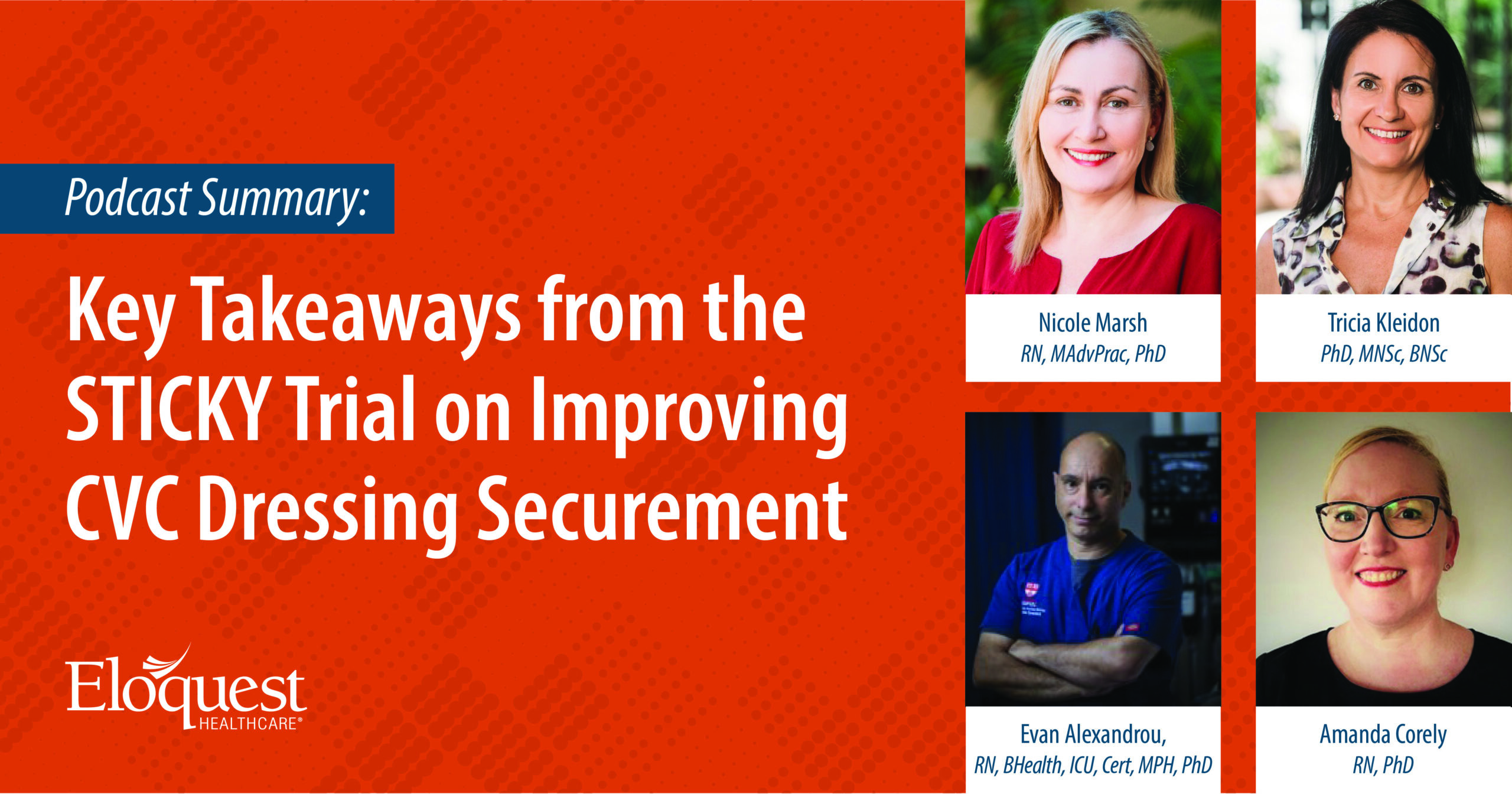
A recent Association for Vascular Access I Save That Podcast episode focused on that challenge, bringing together Nicole Marsh, RN, PhD; Amanda Corley, RN, PhD; Evan Alexandrou, RN, PhD; and Tricia Kleidon, PhD, MNSc, BNSc, to discuss findings from the STICKY Trial.1 The randomized controlled trial evaluated whether a gum mastic medical liquid adhesive (MLA) – specifically Mastisol® Liquid Adhesive – could help prevent dressing failure when used beneath jugular CVC dressings in ICU patients.
A Persistent Bedside Problem
Jugular CVC dressings are among the most difficult to maintain. As Kleidon noted during the podcast, the site “offers more challenges than other sites” because clinicians are trying to secure a dressing on a moving neck.
The consequences are familiar to vascular access and critical care teams: disrupted dressings, unplanned dressing changes, additional nursing workload, increased infection risk, and concern about skin injury at the insertion site.
The STICKY Trial asked a practical question: could a simple adhesive step improve dressing integrity?
The Three-Step Intervention
The product application protocol was straightforward:
- Apply Mastisol around the border of the dressing site.
- Allow the adhesive to dry for approximately 30 seconds.
- Apply the dressing.
That drying period mattered. Alexandrou emphasized during the podcast that if the adhesive is not allowed to dry, the dressing may not adhere properly.
For bedside teams, the intervention was designed to fit into existing practice. Staff applied a narrow line of adhesive where the dressing border would fall, waited the specified dry time, and then placed the dressing contact with the dried adhesive.
Fewer Failures, Fewer Dressing Changes
The trial found that adding gum mastic liquid adhesive to standard jugular CVC dressing protocols significantly improved dressing performance.
Key findings include2:
- 28% dressing failure with MLA versus 50% with standard care
- 64 dressing replacements in the adhesive group versus 124 with standard care
- 58 hours average time to dressing disruption with adhesive versus 26 hours with standard care
Marsh, the trial’s principal investigator, underscored the clinical importance of the issue, noting that effective CVC dressing securement in intensive care is a priority.
The findings suggest that a small change – pretreating the skin with gum mastic liquid adhesive – at the time of dressing placement can help dressings stay intact longer and reduce avoidable replacement.
Implications for Patients and Nurses
Fewer dressing failures may have practical benefits beyond securement alone.
For patients, each unplanned dressing change means another episode of adhesive removal and reapplication. That can be especially concerning for critically ill patients with fragile or compromised skin. In the trial, investigators recorded three medical adhesive-related skin injury events overall—one in the adhesive group and two in the standard-care group. None required further treatment.
For nurses, dressing disruption adds to already busy ICU care. Nearly twice as many dressing replacements were required in the standard-care group, increasing the time clinicians spent responding to dressing failure rather than other patient care priorities.
Supporting the Protective Barrier
The podcast discussion also addressed the role of dressing integrity in infection-prevention efforts. An intact dressing helps maintain a protective barrier over the catheter insertion site.
The STICKY Trial was not powered to show a reduction in bloodstream infections. However, its microbiology substudy found lower levels of microbial colonization at catheter insertion sites in the MLA group, reinforcing the importance of keeping dressings intact.
Designed for Practical Use
One of the trial’s notable findings was that the adhesive did not require facilities to adopt a new dressing platform. The study was conducted across four ICUs in two Australian states using different dressing practices, and Mastisol was incorporated into the dressing protocols already in place.
The trial also estimated approximately $11 AUD in savings per patient, largely from fewer dressing replacements and reduced nursing time.
For teams evaluating dressing securement strategies, that practicality may be important: the intervention was simple, compatible with existing dressings and relatively low cost. Podcast host Judy Thompson stated, “(the study) has the potential to have a profound effect on the standard of care.”
A Small Step with Meaningful Impact
The STICKY Trial challenges the assumption that frequent jugular CVC dressing disruption is unavoidable. The AVA podcast panelists emphasized that improving dressing integrity does not necessarily require a complex solution.
For vascular access and critical care teams, the findings raise a practical question: Could improving dressing adherence help your hospital reduce avoidable interventions later?
To learn more, listen to the AVA I Save That Podcast episode, “Getting Sticky,” which offers 1.0 Continuing Education contact hour until 8/18/26, or read the full study in Critical Care Medicine.

If your team is evaluating ways to improve CVC dressing integrity, contact Eloquest Healthcare to learn how Mastisol Liquid Adhesive may fit into your existing dressing securement protocols.

References:
- Marsh N, O’Brien C, Larsen EN, et al. Securing Jugular Central Venous Catheters With Dressings Fixed to a Liquid Adhesive to Prevent Dressing Failure in Intensive Care Patients (the STICKY Trial): A Randomized Controlled Trial. Critical Care Medicine. 2025;53(2):e282-e293. doi:10.1097/CCM.0000000000006533
- Association for Vascular Access. I Save That Podcast. Getting Sticky. 2026.