
Securement Matters: A Closer Look at AVA’s Clinical Practice Guidelines related to Skin, Dressing Integrity, and Securement
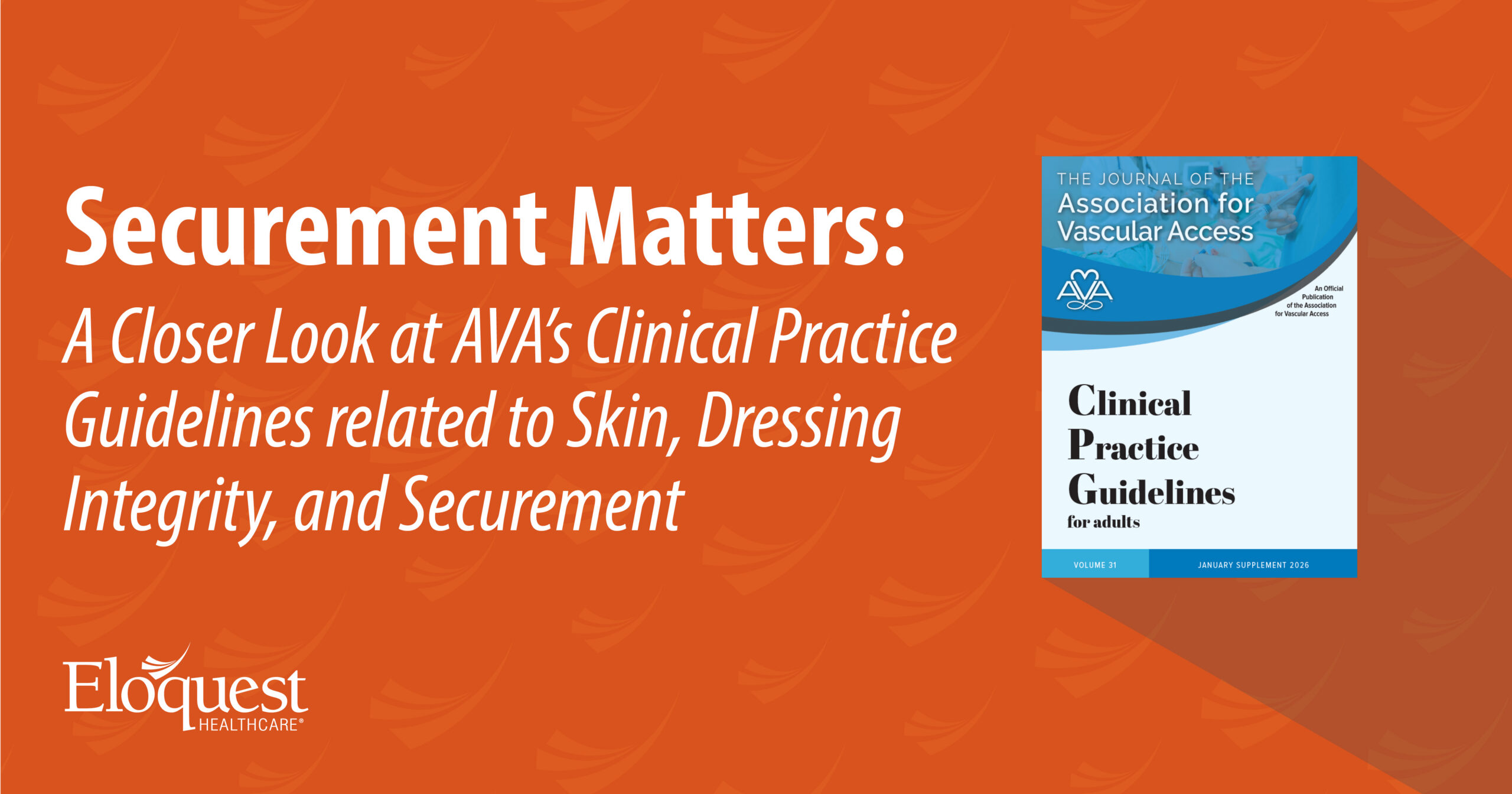
The recently-released Association for Vascular Access (AVA) Clinical Practice Guidelines1 represent more than an update to clinical recommendations. They are a foundational, evidence-based resource designed to protect vessel health, minimize complications, and improve patient outcomes across the continuum of vascular access care.
What makes this inaugural guidance document from AVA particularly impactful is its universal applicability. These guidelines, delivered in five focused sections, are relevant across roles and specialties. If you insert or manage adult vascular access devices, this guidance will help strengthen and standardize your practice.
Within this comprehensive document, Section 5 covers “Ongoing Assessment, Care, & Complication Management.” And Chapter 5.4 homes in on “Management of Skin, Dressings & Securement”. This chapter provides practical direction for clinicians managing vascular access devices. Intent on maintaining skin integrity, dressings, and securement, the section reflects an evolving understanding of how dressing integrity and skin protection influence patient outcomes.
Elevating Prevention in Vascular Access Care
Rather than treating complications as isolated events, Chapter 5.4 emphasizes prevention through proactive assessment, standardized practices, and patient-specific securement strategies. The guidance recognizes that medical adhesive–related skin injury (MARSI), dressing disruption, catheter dislodgement, and therapy interruption often share common upstream causes. Addressing these systematically can reduce variability and improve reliability in vascular access care.
Early Detection and Standardized Response
Within Chapter 5.4, recommendations 1–3 highlight the importance of routine, structured skin assessment. During every vascular access evaluation, clinicians are advised to inspect the insertion site for signs of catheter-associated skin impairment (CASI) or MARSI and to document findings over time. Trend recognition allows early intervention before dressing failure or device instability occurs.
When a compromise (such as inflammation, weeping, granulation tissue, or breakdown) is identified, a structured response protocol should be initiated. This may include adjusting products, escalating care, or incorporating non-adhesive securement options, including subcutaneous anchor securement systems (SASS), to maintain catheter stability without exacerbating skin injury.
These recommendations also reinforce the use of standardized dressing change intervals. Transparent dressings should be changed every seven days unless compromised. Adherence to consistent intervals helps minimize the risk of infection, protect skin integrity, and reduce unplanned device disruption.
Preserving Dressing Integrity While Protecting Skin
Recommendations 6 and 7 within Chapter 5.4 address the balance between dressing durability and skin protection. Adhesive enhancers, such as gum mastic liquid adhesive, are recommended for patients at increased risk of dressing lift due to moisture, skin oils, friction, or movement.2 When utilized, they should be applied according to manufacturer’s instructions and allowed to dry fully before dressing placement. In patients with fragile or compromised skin, clinicians should weigh potential benefits against risk. Skin protection strategies also include applying a sterile barrier film before dressing placement to reduce the risk of MARSI.
Equally important is clinician competency in dressing application and removal. Atraumatic removal techniques—slow, low-angle removal with skin support help reduce skin trauma. Ongoing staff education and competency validation support consistent, safe practice.
Outcome-Driven Securement Strategy
Recommendation 8 reinforces that device securement strategies should be individualized and guided by patient-specific factors, including skin condition, mobility, anatomy, anticipated dwell time, and a history of adhesive-related complications.
Evidence supports consideration of subcutaneous anchor securement systems (SASS) in appropriate patients. In a comparative study of adhesive versus subcutaneous anchor securement systems, researchers found that SASS improved dressing integrity and significantly reduced catheter migration, supporting their role in securing central venous access devices (CVAD) without reliance on sutures.3
The guidance also notes that tissue adhesive alone does not provide sufficient adherence for CVAD securement and may increase the risk of skin injury in adults.
Securement strategies should be reassessed when dressing disruption recurs, catheter migration or device failure occurs, or therapy interruption is observed.
Recommendation 8 reinforces that device securement strategies should be individualized and guided by patient-specific factors, including skin condition, mobility, anatomy, anticipated dwell time, and a history of adhesive-related complications.
Evidence supports consideration of subcutaneous anchor securement systems (SASS) in appropriate patients. In a comparative study of adhesive versus subcutaneous anchor securement systems, researchers found that SASS improved dressing integrity and significantly reduced catheter migration, supporting their role in securing central venous access devices (CVAD) without reliance on sutures.3
The guidance also notes that tissue adhesive alone does not provide sufficient adherence for CVAD securement and may increase the risk of skin injury in adults.
Securement strategies should be reassessed when dressing disruption recurs, catheter migration or device failure occurs, or therapy interruption is observed.
Applying Chapter 5.4 Across the Vascular Access Lifecycle
Chapter 5.4 underscores prevention, consistency, and adaptability as core principles of effective vascular access management. Early assessment, preservation of dressing integrity, skin protection, and outcome-driven securement are interdependent components of high-reliability vascular access management.
When applied systematically, these principles reduce complications, enhance device stability, and support safer vascular access care across diverse patient populations and care settings.
As vascular access guidance evolves, our approach to skin protection, dressing integrity, and securement must evolve as well.
Connect with Eloquest Healthcare to implement solutions that align with these evidence-based recommendations.
Editor’s Note: This publication is available for free to members of the Association for Vascular Access. To purchase a copy, visit https://www.avainfo.org/page/cpg.

References:
- Association for Vascular Access. Clinical Practice Guidelines for Adult Vascular Access. Journal of the Association for Vascular Access. 2026;31(Suppl 1).
- DeVries, M; Sarbenoff, J; Scott, N; Wickert, M; Hayes, L. Improving Vascular Access Dressing Integrity in the Acute Care Setting, Journal of Wound, Ostomy and Continence Nursing: June 28, 2021 – Volume Publish Ahead of Print – Issue – doi: 10.1097/WON.0000000000000787
- Bell JA, Hawes M, Diloreto E, Gibson SM. Systematic Review of the Safety and Efficacy of Central Vascular Access Device Securement. Journal of the Association for Vascular Access.1 September 2022; 27 (3): 15–35. doi: https://doi.org/10.2309/JAVA-D-22-00013.
- Association for Vascular Access. Clinical Practice Guidelines for Adult Vascular Access. Journal of the Association for Vascular Access. 2026;31(Suppl 1).
- DeVries, M; Sarbenoff, J; Scott, N; Wickert, M; Hayes, L. Improving Vascular Access Dressing Integrity in the Acute Care Setting, Journal of Wound, Ostomy and Continence Nursing: June 28, 2021 – Volume Publish Ahead of Print – Issue – doi: 10.1097/WON.0000000000000787
- Bell JA, Hawes M, Diloreto E, Gibson SM. Systematic Review of the Safety and Efficacy of Central Vascular Access Device Securement. Journal of the Association for Vascular Access.1 September 2022; 27 (3): 15–35. doi: https://doi.org/10.2309/JAVA-D-22-00013.