
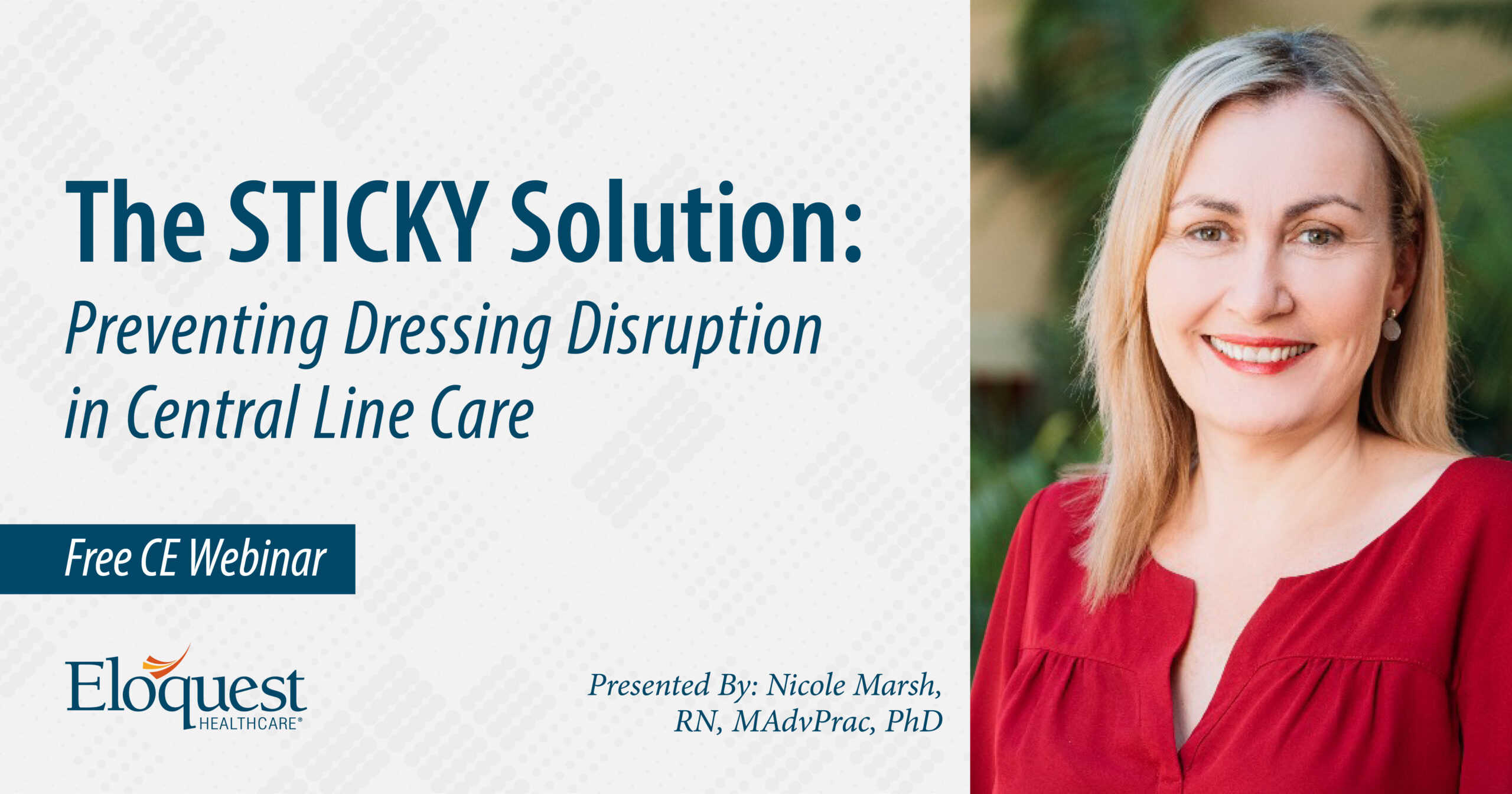
The STICKY Trial, Revisited: Deeper Clinical Insights and Lessons Learned
A recent webinar hosted by the Association for Vascular Access (AVA) featuring Nicole Marsh, PhD, RN, offered a rare look at the clinical challenges and decision-making behind the STICKY Trial, offering insight well beyond what appears in the published manuscript.
This session discussed the trial outcomes as well as the why behind their research interest: the persistent problem of jugular central venous catheter (CVC) dressing failure, how early edge lift drives downstream complications, and why dressing integrity deserves renewed attention in infection-prevention strategies.
Importantly, these insights are now echoing well beyond the original research team.
During her 2025 AACN NTI session, “Critical Care Studies You Should Know About: A Year in Review,” critical care Clinical Nurse Specialist Nicole Kupchik, MN, RN, CCNS, CCRN, PCCN, spotlighted the STICKY Trial as a study with immediate bedside relevance.
According to Kupchik, “A lot of hospitals are still struggling with CLABSIs, and one of the things we think is contributing is dressing failure, especially with jugular lines, where torque and neck movement peel back the dressing. And we all know, once a dressing fails, the infection risk goes up.”
Her framing reinforces a key takeaway from Marsh’s webinar: dressing failure is not a nuisance problem; it is a systems problem with safety and cost implications.
A Program of Research Rooted in Real ICU Challenges
Dr. Marsh opened the webinar by describing the real-world securement issues that initially sparked the research. In her ICU, jugular CVC dressings were failing early and frequently due to humidity, diaphoresis, patient movement, multiple infusion sets, and beard regrowth.
“We were having difficulties with securing our central venous catheter dressings,” Marsh said, “particularly in the jugular location where humidity, diaphoresis, and multiple infusion sets were contributing to dressing edges lifting.”
Early feasibility work revealed that dressings could fail within 24–25 hours, a concerning finding given existing evidence that repeated dressing disruption increases the likelihood of catheter-related bloodstream infection (CRBSI).
What Early Feasibility Work Revealed—and Ruled Out
Before launching the STICKY Trial, Marsh’s team conducted a randomized feasibility study comparing multiple dressing and securement combinations. During the webinar, she shared details of this prior clinical work, particularly around cyanoacrylate tissue adhesive.
“After 23 patients, we had a 17% central venous catheter failure rate, and all of these were from dislodgement,” she said.
Additional challenges included delayed drying in diaphoretic or coagulopathic patients, discomfort during removal, and interference from beard regrowth. These findings made it clear that tissue adhesive alone was not a viable solution for jugular CVC securement, prompting the search for an alternative.
Discovering Medical Liquid Adhesive (MLA) as a Targeted Solution
Marsh first encountered a medical liquid adhesive (MLA), a non–water-soluble gum mastic, while walking through the exhibit hall at an AVA Annual Scientific Meeting.
Marsh noted, “I came across a medical liquid adhesive that had been used in wound dressings with promising results.”
Because MLA is applied specifically at the skin–dressing interface, it directly addressed the failure point her ICU was experiencing — border lift rather than catheter migration.
Designing the STICKY Trial for Real-World Practice
One of the most instructive aspects of the webinar was how deliberately the STICKY Trial was designed to reflect everyday ICU workflows.
Rather than standardizing dressing products across four hospitals, each site continued using its existing dressing protocol, with MLA added only for the intervention group. This approach:
- Preserved local practice patterns
- Minimized staff disruption
- Allowed realistic assessment of MLA’s incremental benefit
A similarly pragmatic approach was used for cost analysis, incorporating dressing supplies, staff time, diagnostic utilization, and complication-related expenses. The result: approximately $11 AUD per patient in savings in the MLA group, driven by fewer dressing changes and reduced failure rates.
Skin Safety and MARSI: A Non-Negotiable Priority
Given the fragility of ICU patient skin, preventing medical adhesive-related skin injury (MARSI) was a central focus of the study.
Daily assessments, structured documentation, and inter-rater reliability testing ensured consistent MARSI evaluations across sites, reinforcing that improved adhesion need not come at the expense of skin integrity.
Microbiology Signals Worth Watching
Although not statistically powered, the microbiology sub-study offered intriguing signals:
- 8 of 10 control samples showed bacterial growth
- 4 of 10 MLA samples showed bacterial growth
Half of the positive cultures were Staphylococcus epidermidis, a common pathogen of bloodstream infections. While preliminary, these findings support the hypothesis that improved dressing border integrity may reduce microbial exposure at the insertion site.
Why the STICKY Trial Is Resonating Now
As Kupchik emphasized in her NTI review, jugular line management remains a persistent challenge in ICUs worldwide, and dressing failure is a modifiable risk factor hiding in plain sight.
The STICKY Trial is helping reframe securement not as a product choice, but as a practice strategy—one that intersects infection prevention, nursing workload, patient comfort, and cost containment.
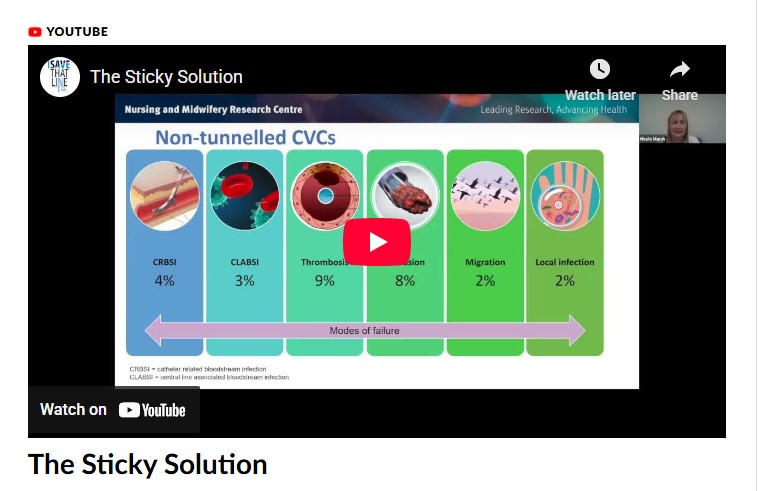
The webinar is available on demand through the AVA Academy and includes free Continuing Education Contact Hours.
Watch: “The STICKY Solution: Preventing Dressing Disruption in Central Line Care.”
Eloquest Healthcare is proud to support clinical education that helps translate evidence into practice. To receive updates on future programs and clinical insights, register here.
For general inquiries or additional information, contact us or call 1-877-433-7626.