

Can a Hemostatic Dressing Help Protect VAD Insertion Sites from Pathogens?
For a critically ill patient, persistent bleeding at a vascular access device (VAD) insertion site can set off a frustrating cycle: another dressing change, another attempt to control the bleeding, and more disruption at the bedside.
Critical care nurse Jamie Hepps, RN, BSN, described one such patient during an episode of the Association for Vascular Access (AVA)’s I Save That Podcast. Despite several interventions—including an additional stitch placed by a surgeon—the dressing still needed changing approximately every one to two hours. After the team applied OMNI-STAT®, Hepps recalled, bleeding stopped within about 10 minutes, and the dressing did not need changing for almost 24 hours.
Her account describes one patient’s experience, not a result clinicians should expect in every case. But it illustrates why access-site bleeding matters beyond the procedure itself—and why researchers are exploring what a hemostatic dressing might contribute beyond bleeding control.
For a critically ill patient, persistent bleeding at a vascular access device (VAD) insertion site can set off a frustrating cycle: another dressing change, another attempt to control the bleeding, and more disruption at the bedside.
Critical care nurse Jamie Hepps, RN, BSN, described one such patient during an episode of the Association for Vascular Access (AVA)’s I Save That Podcast. Despite several interventions—including an additional stitch placed by a surgeon—the dressing still needed changing approximately every one to two hours. After the team applied OMNI-STAT®, Hepps recalled, bleeding stopped within about 10 minutes, and the dressing did not need changing for almost 24 hours.
Her account describes one patient’s experience, not a result clinicians should expect in every case. But it illustrates why access-site bleeding matters beyond the procedure itself—and why researchers are exploring what a hemostatic dressing might contribute beyond bleeding control.
The Bedside Challenge Behind the Research
“Finding hemostasis for our patient population is always very difficult,” Hepps said, describing cardiovascular intensive care unit patients who often require multiple lines and receive anticoagulants. She and podcast host Judy Thompson, MSN Ed., RN, VA-BC, discussed how repeated dressing changes can add to nursing workload, irritate the skin, and cause distress for patients and families.
Interventional cardiologist and poster coauthor Brian Corbett, DO, FACOI, brought a procedural perspective. As patients and procedures become more complex, he explained, managing vascular access and controlling bleeding remain essential parts of care, even after an otherwise successful procedure.
A poster presented at AVA 2026 connects those concerns with a research question: Could a hemostatic dressing help limit bacterial growth when bleeding delays application of a standard antimicrobial disc or dressing? The investigators explored whether the dressing could serve as a temporary bridge during that interval.
What the Researchers Studied
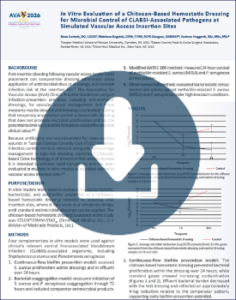
Corbett and fellow investigators Matthew Regulski and Andrew Hoggarth evaluated CELOX®/OMNI-STAT®, a chitosan-based hemostatic dressing, in four laboratory models. Testing included organisms associated with central line-associated bloodstream infections (CLABSIs): Staphylococcus aureus, methicillin-resistant S. aureus (MRSA), and Pseudomonas aeruginosa.
The models examined bacterial growth within dressings, bacterial clustering, and survival after contact with dressing samples—not infections in patients.
Limiting Bacterial Growth and Clustering
In a continuous-flow model, the dressing prevented S. aureus proliferation within the dressing over 24 hours, while standard gauze showed increasing contamination. Bacterial burden in fluid leaving the test dressing also decreased, supporting early biofilm-prevention potential under the conditions studied.
A second model examined coaggregation—the clustering of bacteria together. The dressing completely inhibited coaggregation of S. aureus and P. aeruginosa at 24 hours and maintained greater than 75% inhibition at 72 hours. It outperformed the comparator antimicrobial wound dressing and gel within this specific model.
Examining Bacterial Survival
Testing using a modified American Association of Textile Chemists and Colorists (AATCC) 100 method showed approximately 1.5-log reductions in both MRSA and P. aeruginosa at 24 hours. The investigators characterized these findings as a bacteriostatic, or growth-inhibiting, effect.
Direct-contact testing showed bactericidal, or bacteria-killing, activity against P. aeruginosa, with a 3.16-log reduction, and bacteriostatic activity against MRSA, with a 1.85-log reduction. The effects differed by organism and test method.
What These Findings Could Mean for Care
The podcast’s clinical perspectives explain why this research matters: clinicians managing persistent bleeding are also working toward a dressing that stays intact. A hemostatic dressing with microbial-control properties could potentially support care during that transition.
All testing was conducted in vitro, and the authors noted limitations related to sample size and replication. Further clinical studies are needed to establish that OMNI-STAT prevents CLABSIs or reduces infections in patients. The proposed role is a temporary bridge not a replacement for standard antimicrobial dressings or established infection-prevention practices.
Listen to the Podcast for the Clinical Perspective
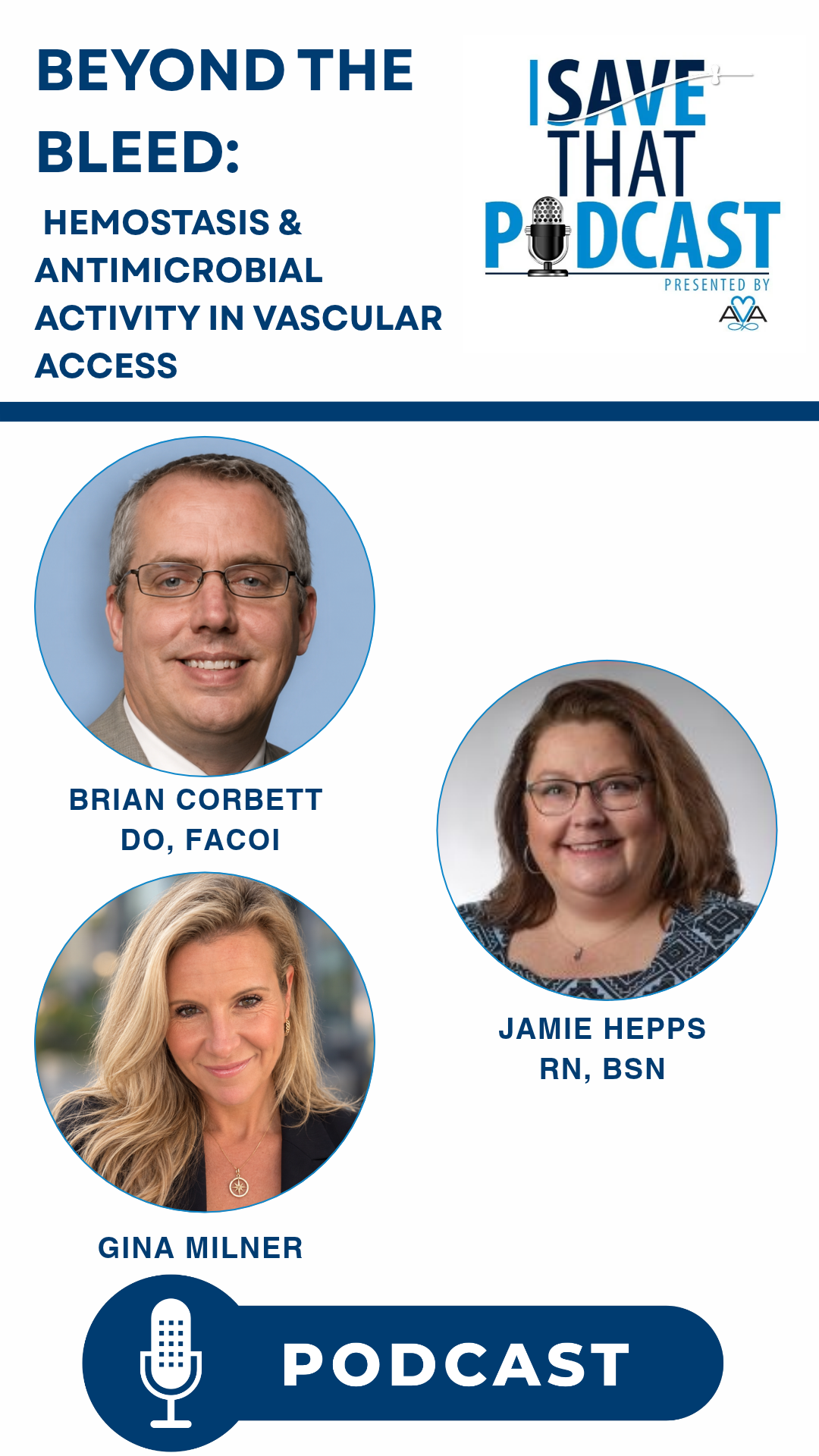
Join Judy Thompson, Dr. Brian Corbett, Jamie Hepps, and Gina Milner on AVA’s I Save That Podcast for the full discussion of access-site bleeding, bedside experiences, and practical considerations for hemostatic products.
Explore the podcast episode on AVA’s website.
For the laboratory methods, results, and figures, download the poster handout.
Disclosures
The podcast was sponsored by Eloquest Healthcare in partnership with Omni-stat Medical Inc. Andrew Hoggarth is Research and Development Director of Medtrade Products, Ltd. The other poster authors declared no competing interests. The poster was developed with funding from Medtrade Products, Ltd.
References
Thompson J, host. Beyond the bleed: hemostasis and antimicrobial activity in vascular access. ISAVE That Podcast. Association for Vascular Access; October 27, 2026. Accessed October 30, 2026. https://www.avainfo.org/page/podcastpublic
Corbett B, Regulski M, Hoggarth A. In vitro evaluation of a chitosan-based hemostatic dressing for microbial control of CLABSI-associated pathogens at simulated vascular access insertion sites. Poster presented at: Association for Vascular Access Annual Scientific Meeting; October 3-5, 2026; Grapevine, TX.