
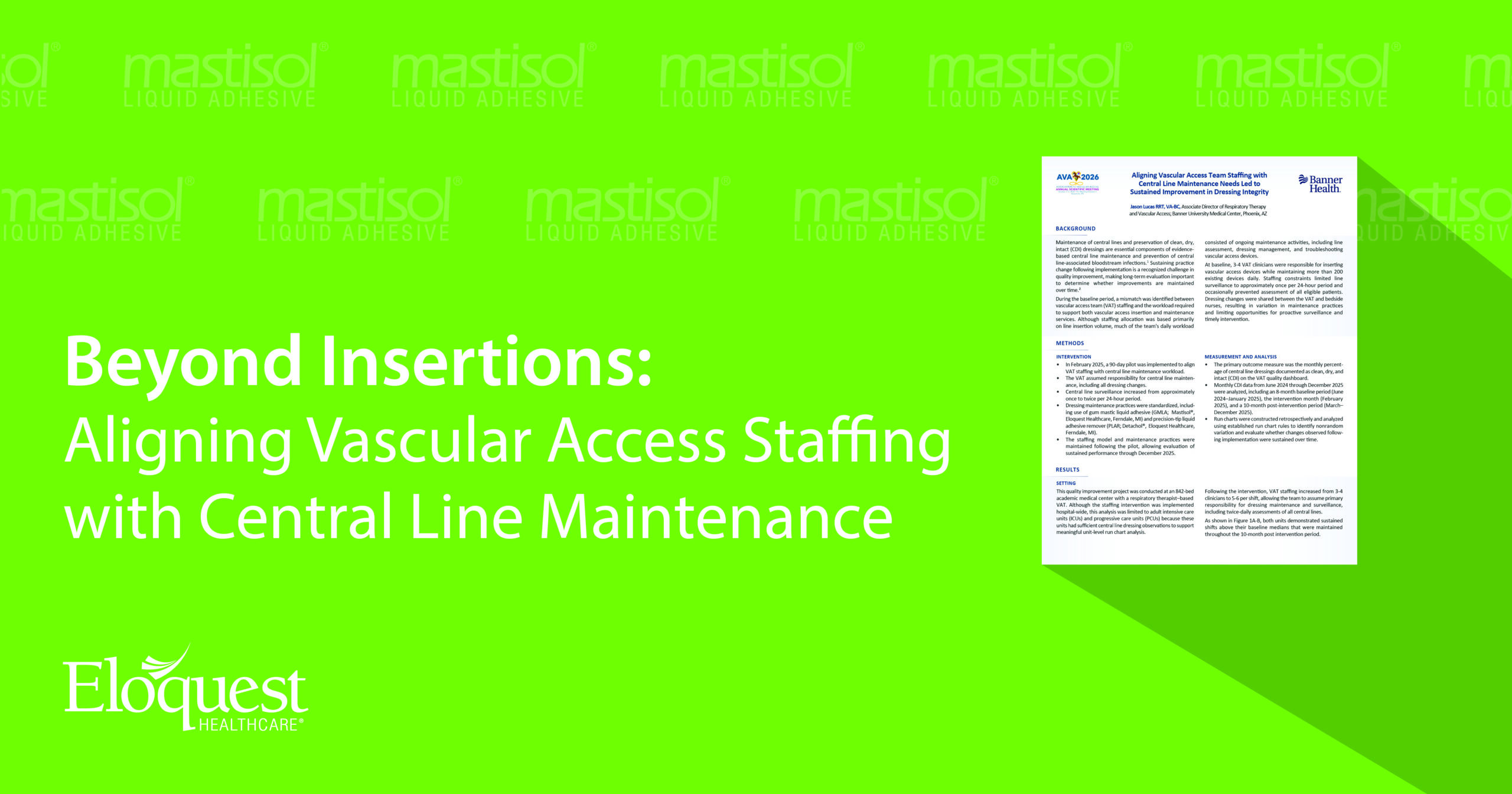
Beyond Insertions: Aligning Vascular Access Staffing with Central Line Maintenance
At the 2026 Association for Vascular Access (AVA) Annual Scientific Meeting, Jason Lucas, RRT, VA-BC, of Banner University Medical Center Phoenix, presented a quality improvement initiative demonstrating sustained improvements in central line dressing integrity following changes to vascular access team (VAT) staffing and maintenance practices.
The initiative addressed a common challenge: VAT staffing models often emphasize catheter insertions, despite the substantial workload required to maintain existing vascular access devices.
For Lucas, the staffing challenge directly affected the team’s ability to provide specialized maintenance care. “We just didn’t have the bandwidth to see all of the lines,” Lucas said.
The Intervention: Aligning Staffing with Maintenance Needs
Before the intervention, three or four VAT clinicians per shift were responsible for insertions and maintenance of more than 200 existing vascular access devices daily. Staffing constraints limited central line surveillance to approximately once daily, while dressing changes were shared between VAT clinicians and bedside nurses.
In February 2025, the hospital introduced a maintenance-focused staffing model, increasing VAT staffing to five or six clinicians per shift. The VAT assumed primary responsibility for central line dressing changes, and routine surveillance increased from approximately once to twice daily.
“I’ve been working with the same team for five years and then until we got the staffing pilot and got the staff, that’s when we finally were able to move the needle,” Lucas said.
Standardizing Central Line Maintenance
Alongside staffing changes, the team standardized maintenance practices using two products:
- Mastisol® Liquid Adhesive: A gum mastic liquid adhesive used to support dressing adherence.
- Detachol® Adhesive Remover: Used to facilitate adhesive removal during dressing changes.
These products were incorporated into a broader strategy emphasizing consistent dressing care, routine surveillance, and timely intervention when dressing integrity was compromised.
Because the changes were implemented together, the results reflect the combined effects of increased staffing, expanded VAT responsibilities, more frequent surveillance, and standardized maintenance practices. The independent contribution of either product cannot be determined.
Tracking Dressing Integrity Over Time
Lucas presented 19 months of data from the VAT quality dashboard, spanning June 2024 through December 2025. The dashboard tracked the monthly percentage of central line dressings documented as clean, dry, and intact (CDI) in intensive care units (ICUs) and progressive care units (PCUs).
“We round on all patients with central lines,” Lucas explained. During rounds, the team recorded dressing assessments in its dashboard and communicated discrepancies to unit leaders for follow-up.
Run charts displayed eight months of baseline data, the February 2025 intervention, and 10 months of follow-up. By plotting monthly CDI performance against baseline medians, the charts allowed the team to assess whether improvements were sustained over time.
Sustained Improvement in Dressing Integrity
The ICU baseline median CDI rate was 87.0%, compared with approximately 94.7% in the PCU.
Following implementation, both settings demonstrated at least six consecutive monthly observations above their respective baseline medians, a pattern consistent with a sustained shift in performance.
Monthly CDI performance remained above baseline medians through December 2025, indicating that improvements persisted throughout the 10-month follow-up period.
The complete run charts, including the magnitude and month-to-month variation in dressing integrity, are available in Lucas’s AVA poster.
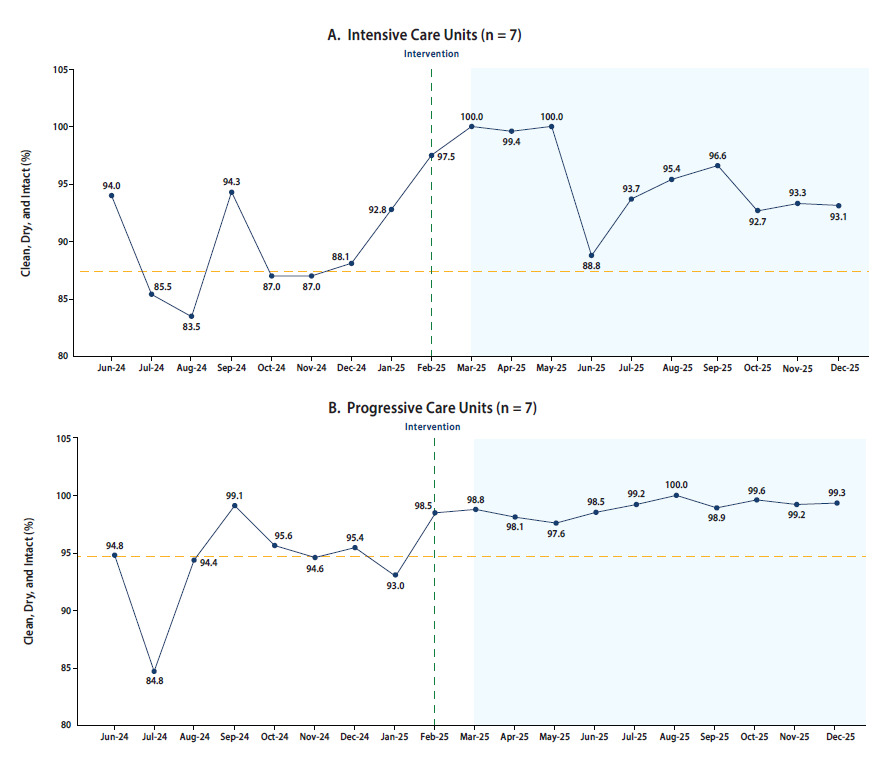
Monthly Central Line Dressing Integrity (CDI) by Unit Before and After the Intervention
Implications for Vascular Access Practice
The initiative demonstrates how aligning VAT staffing with maintenance workload, together with standardized practices and ongoing surveillance, can support sustained improvements in central line dressing integrity. It also highlights the value of longitudinal quality monitoring. The VAT dashboard provided evidence that improvements persisted over time.
Does your VAT staffing model account for the work required to maintain the devices already in place?
Discover how one health system approached this challenge and tracked sustained improvements in dressing integrity across ICU and PCU settings.
Download the Poster to Explore the Findings
Eloquest Healthcare is committed to providing solutions that can help improve dressing integrity and durability while saving time and reducing unnecessary costs. For more information about the products assessed in this quality improvement initiative, please complete this form.
References:
Lucas J. Aligning Vascular Access Team Staffing with Central Line Maintenance Needs Led to Sustained Improvement in Dressing Integrity. Poster presented at: Association for Vascular Access Annual Scientific Meeting; October 3-5, 2026; Grapevine, TX.