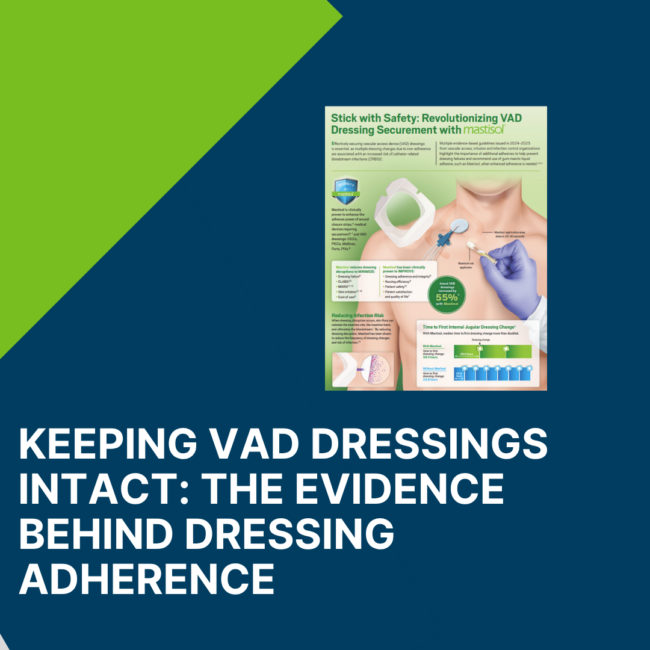


Keeping VAD Dressings Intact: The Evidence Behind Dressing Adherence

Keeping VAD Dressings Intact: The Evidence Behind Dressing Adherence Maintaining vascular access device (VAD) dressing integrity is a well-established component of safe vascular access care. When a dressing lifts, loosens or otherwise becomes compromised, an unplanned dressing change may be necessary. This creates additional opportunities for site manipulation and potential contamination. Dressing disruption has been…

Image of Martha Button

3 Questions with Martha Button

3 Questions with Martha Button, MSN, RN, VA-BC “3 Questions With…” is a video series showcasing thought leaders in healthcare specialties like Infection Prevention and Vascular Access. These experts provide insights, evidence, and best practices in response to pressing questions in their fields. Eloquest Healthcare is proud to feature 3 Questions with Martha Button, MSN,…

Podcast Summary Key Takeaways from the STICKY Trial on Improving CVC Dressing Securement

Podcast Summary: Key Takeaways from the STICKY Trial on Improving CVC Dressing Securement Central venous catheter (CVC) dressings are meant to protect the insertion site. But in the ICU, especially with jugular CVCs, keeping those dressings intact can be difficult. Movement, moisture, perspiration, hair growth and the anatomy of the neck can all contribute to…

Solutions in Practice: Mastisol Use on Pediatric PICC Dressings with Denaye Beckler

Solutions in Practice: Mastisol Use on Pediatric PICC Dressings with Denaye Beckler When it comes to pediatric vascular access, dressing integrity matters. Frequent dressing disruption can create challenges for clinicians, patients, and families. In this featured Solutions in Practice video, pediatric vascular access expert Denaye Beckler, MSN, APRN, CPNP-AC, CEN, VA-BC, shares how Mastisol® Liquid…

Title Page

The STICKY Trial, Revisited: Deeper Clinical Insights and Lessons Learned

The STICKY Trial, Revisited: Deeper Clinical Insights and Lessons Learned A recent webinar hosted by the Association for Vascular Access (AVA) featuring Nicole Marsh, PhD, RN, offered a rare look at the clinical challenges and decision-making behind the STICKY Trial, offering insight well beyond what appears in the published manuscript. This session discussed the trial…

2025 Year in Review

2025 Year in Review Thank you for being part of the Eloquest Healthcare Blog community throughout 2025! We’re grateful for your readership and hope our articles have informed, inspired, and strengthened your clinical practice. Below is a roundup of this year’s top-engaged posts. We invite you to revisit and share your favorites: When CVC dressings…

From Confusion to Clarity: Shedding Light on Adhesive Terminology in Vascular Access

From Confusion to Clarity: Shedding Light on Adhesive Terminology in Vascular Access At the AVA 2025 Annual Scientific Meeting, vascular access expert Matt Gibson, RN, VA-BC, CRNI, CPUI, addressed an issue that many clinicians face daily but rarely pause to examine: adhesives. His poster, “Device Securement and Dressing Adherence: Clarifying Medical Liquid Adhesive Terminology for…

Image for blog

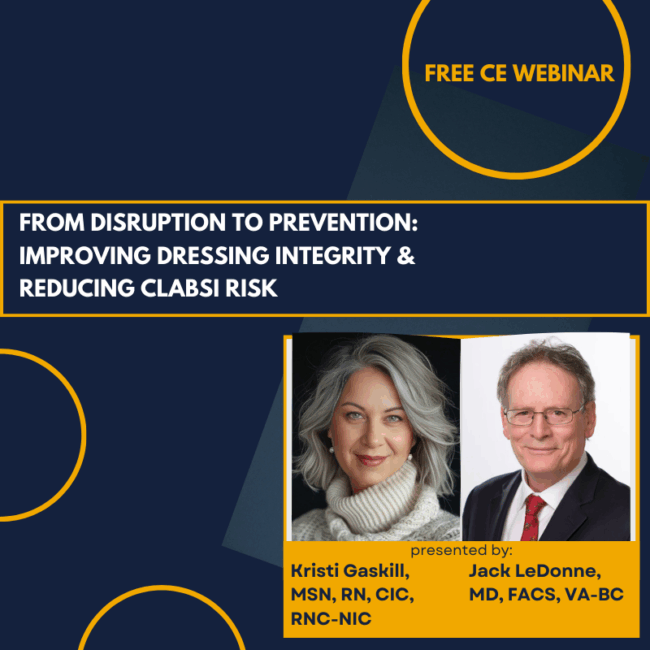
From Disruption to Prevention: A Clinical Summary of the Gaskill & LeDonne Webinar on Dressing Integrity and CLABSI Risk

From Disruption to Prevention: A Clinical Summary of the Gaskill & LeDonne Webinar on Dressing Integrity and CLABSI Risk Earlier this year, Eloquest Healthcare sponsored the educational webinar From Disruption to Prevention: Improving Dressing Integrity and Reducing CLABSI Risk, featuring Kristi Gaskill, MSN, RN, CIC, and Jack LeDonne, MD, VA-BC. This evidence-based session focused on…

Adhesive Advantage: How the STICKY Trial Highlights Medical Liquid Adhesive’s Role in Microbial Control. Includes example image of intact, secure dialysis catheter and dressing.

Adhesive Advantage: How the STICKY Trial Highlights Medical Liquid Adhesive’s Role in Microbial Control

Adhesive Advantage: How the STICKY Trial Highlights Medical Liquid Adhesive’s Role in Microbial Control When it comes to preventing hospital-onset bacteremia (HOB), even the smallest breach in a catheter dressing can serve as an entry point for pathogenic microorganisms. Every year, patients and hospitals pay a steep price for infections caused by compromised dressings, leading…