
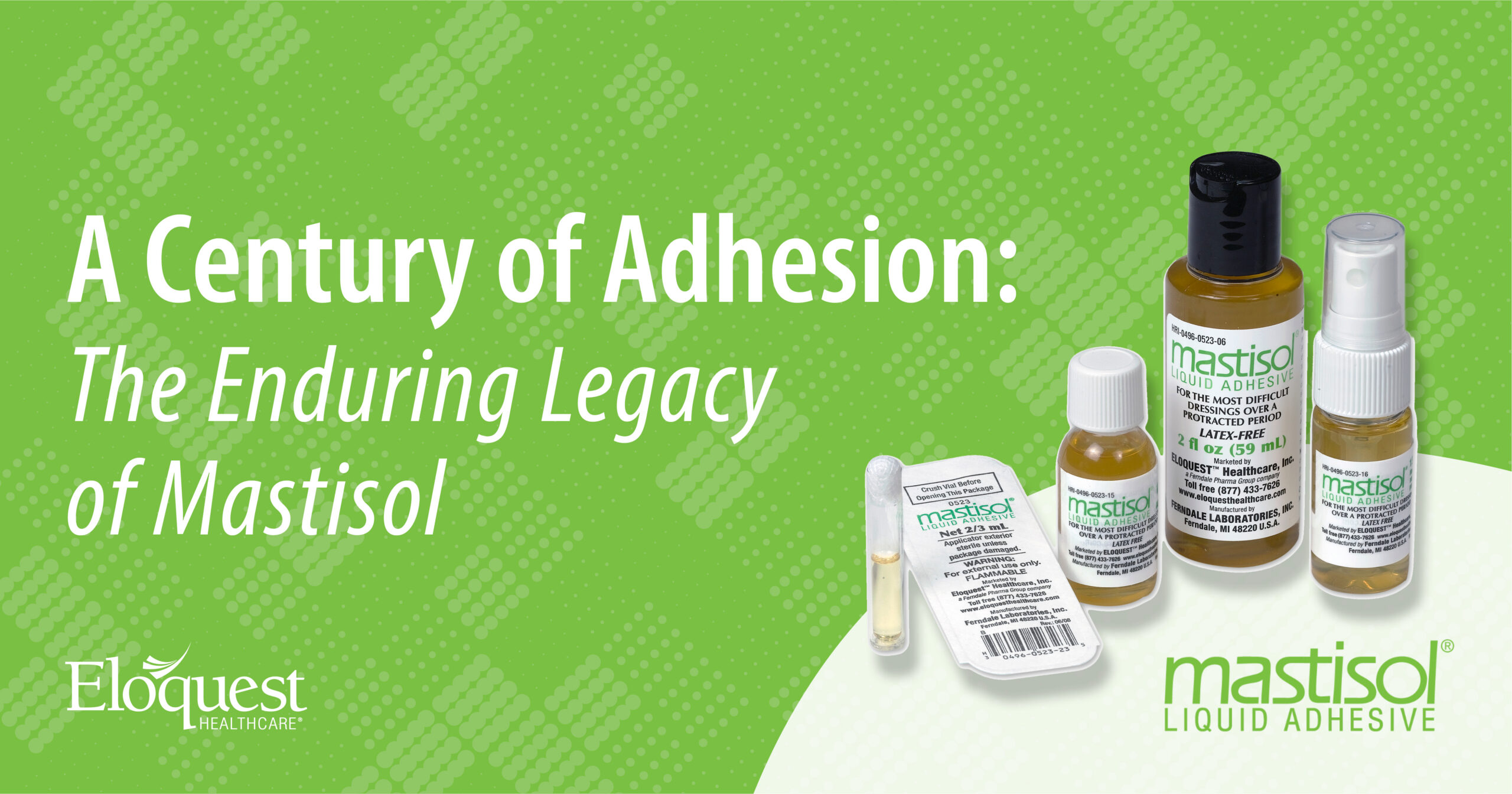
A Century of Adhesion: The Enduring Legacy of Mastisol
More than a century before medical liquid adhesive became standard, clinicians faced a fundamental challenge: how to keep wound coverings in place on fragile, often moist skin. At the turn of the 20th century, one solution began to stand apart.
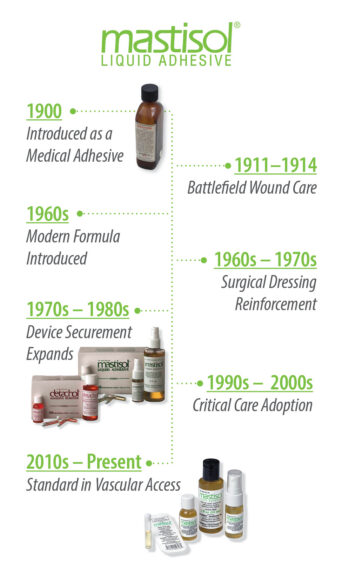
Mastisol was introduced around 1900 and quickly gained attention in early surgical literature. Dr. von Oettinger of Berlin, director of a German field hospital during the Balkan War, is credited with modifying an earlier adhesive formula and recommending it for wound care.¹ In 1914, The Lancet described Mastisol as a “proprietary preparation consisting of a solution of mastic and other resins,” noting its adhesive properties at a time when dependable skin adhesion was rare.²
That early validation marked the beginning of a product life span unusual in modern medicine. Mastisol has remained in clinical use for more than a century—its longevity reflecting not nostalgia, but an ongoing ability to meet practical clinical needs across evolving care environments.
Early Use in Wound Management
In the early 1900s, wound care relied largely on gauze, bandages, and mechanical fixation. Adhesive tapes as they are known today did not yet exist. Surgeons experimented with rubber, waxes, and resin-based sealants, but most proved unreliable or impractical. Mastisol emerged as a notable exception, demonstrating consistent adhesion to intact skin and earning a place in early wound-management practice.³
Establishing a Standard Formulation
In the 1960s, Mastisol® Liquid Adhesive was introduced in the gum mastic formulation that remains in use today. As hospitals modernized in the decades that followed, the product became embedded in routine care, adapting to new clinical demands while maintaining its original purpose: keeping dressings secure.
Integration into Surgical and Orthopedic Care
By the mid-20th century, Mastisol was widely used across surgical specialties. Surgeons applied it to reinforce postoperative dressings in areas prone to moisture or movement and to reduce wound tension in dermatologic and plastic procedures.⁴⁻⁵ Orthopedists also adopted Mastisol beneath casts and splints, where prolonged immobilization placed additional stress on dressings and underlying skin.
Supporting the Growth of Intravenous Therapy
From the 1960s through the 1990s, advances in intravenous therapy, central venous access, and regional anesthesia introduced new adhesion challenges. Dressings securing vascular access devices and anesthesia catheters required durability without sacrificing skin integrity. Mastisol’s ability to maintain adhesion over extended periods—while accommodating patient movement—made it a practical solution during this expansion of device-based care.
Use in Critical Care Environments
As intensive care units became standard in hospitals from the 1970s through the early 2000s, Mastisol followed clinicians into high-acuity settings. It was used to secure central lines, ventilator tubing, and other critical devices in environments characterized by moisture, frequent repositioning, and prolonged wear—conditions where dressing failure could have serious consequences.
Contemporary Clinical Use
Today, Mastisol continues to be used in advanced wound care and specialty dressings, though its most well-documented contemporary role is in vascular access management. In this setting, securement and dressing integrity are central to infection prevention.
Current clinical guidance emphasizes maintaining intact dressings to minimize contamination and avoid unplanned changes. The Centers for Disease Control and Prevention recommends replacing vascular access dressings at least every seven days,⁶ and Standard 42 of the Infusion Therapy Standards of Practice directs clinicians to use gum mastic adhesives such as Mastisol when enhanced adhesion is needed due to diaphoresis, drainage, or bleeding.⁷ By supporting dressing integrity and reducing early or unplanned changes, Mastisol may also contribute to patient safety efforts aimed at reducing central line–associated bloodstream infections.⁸
A Legacy That Endures
In an era defined by rapid technological change, Mastisol’s continued clinical use underscores a simple reality: some healthcare challenges remain constant. Reliable adhesion to intact skin is one of them. Mastisol’s century-long presence illustrates how certain tools endure not because of tradition, but because they continue to solve practical problems that newer technologies do not fully replace.
To learn more about Mastisol or order a product sample, contact Eloquest Healthcare at 1-877-433-7626 or complete this form.

References:
- Merck & Co. Merck’s Annual Report of Recent Advances in Pharmaceutical Chemistry and Therapeutics. Vol 22. Rahway, NJ: Merck & Co; 1913:86-87.
- The Lancet. The War. Lancet. 1914;184(4762):1335.
- Transactions of the German Surgical Congress, held April 19–22, 1911. Fortieth Congress. Ann Surg. 1911;54:131. Translated by Joers O, Lederer M, Pilcher JT.
- Lesesne CB. The postoperative use of wound adhesives: gum mastic versus benzoin, USP. J Dermatol Surg Oncol. 1992;18(11):990. doi:10.1111/j.1524-4725.1992.tb02771.x
- Moy RL, Quan MB. An evaluation of wound closure tapes. J Dermatol Surg Oncol. 1990;16(8):721-723. doi:10.1111/j.1524-4725.1990.tb00110.x
- O’Grady NP, Alexander M, Burns LA, et al. Guidelines for the prevention of intravascular catheter-related infections. Clin Infect Dis. 2011;52(9):1087-1099.
- Nickel B, Gorski L, Kleidon T, et al. Infusion therapy standards of practice, 9th edition. J Infus Nurs. 2024;47(1S Suppl 1):S1-S285. doi:10.1097/NAN.0000000000000532
- Gaskill K, Wilder K, Sneed E, Pujals AJ, Newman K. Improving maintenance of central line dressing to reduce risk of central line–associated bloodstream infections in an acute-care setting. HCA Healthc J Med. 2024;5(5):569-576. doi:10.36518/2689-0216.2025