
A Better Standard for Rapid Hemorrhage Control in Hospitals
Uncontrolled bleeding remains one of the most urgent challenges in trauma and acute care. Despite advances in surgical techniques and resuscitation protocols, hemorrhage continues to be a leading cause of preventable death following injury.
What clinicians know from both military and civilian trauma systems is simple: the faster bleeding stops, the better the chances of survival. Rapid hemorrhage control reduces blood loss, stabilizes patients earlier, and improves outcomes across the continuum of care. Yet many hospitals still lack standardized solutions for rapid bleeding control outside the operating room.
The Growing Focus on Early Bleeding Control
Over the past decade, initiatives such as ‘Stop the Bleed’ have reshaped how clinicians and communities think about trauma care. The focus has shifted toward controlling hemorrhage as early as possible, often before a patient even reaches the hospital.
Pre-hospital providers, first responders, and trauma teams now recognize that time to hemostasis is a critical determinant of survival.
While surgical hemostatic agents are effective within the controlled environment of the operating room, their cost, specialized storage requirements, and the required training needed can limit their use in emergency departments, trauma bays, ICUs, or procedural suites. This creates a gap in hospital bleeding management, particularly in settings where rapid intervention is needed but surgical resources are not immediately available or practical.
A Practical Solution: Temporary Topical Hemostatic Agents
Temporary topical hemostatic agents are designed to quickly control external bleeding and stabilize patients until definitive care can be delivered.
Among these technologies, chitosan-based hemostatic agents have emerged as a valuable tool across both pre-hospital and in-hospital environments. Chitosan is a positively charged organic polymer that interacts directly with red blood cells to form a durable gel-like clot. Unlike some other hemostatic technologies, this process does not rely on the body’s clotting cascade.
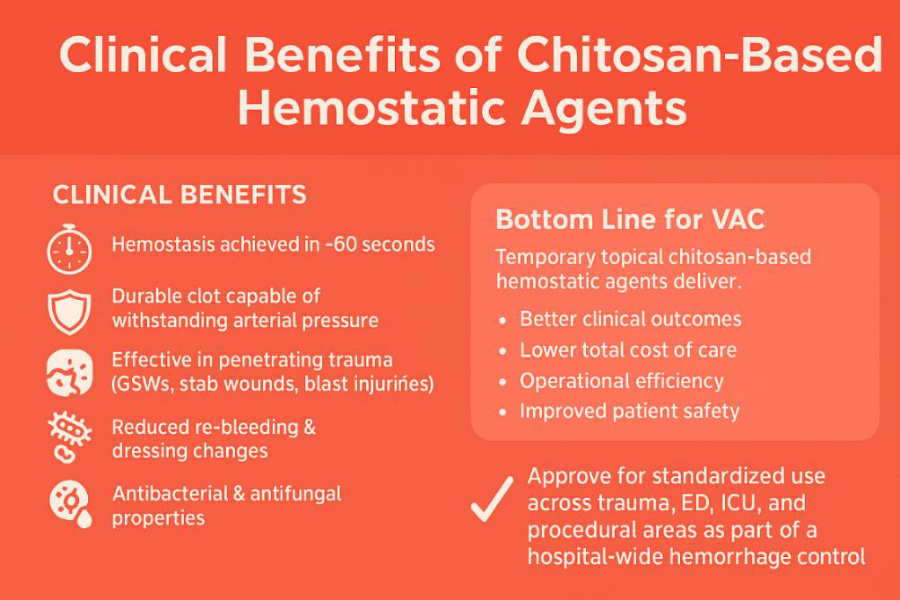
Omni-Stat® is a chitosan-based hemostatic agent designed to provide this rapid bleeding control in simple, easy-to-apply formats. Chitosan-based hemostatic agents can remain effective in patients who are:
- Receiving anticoagulant therapy
- Experiencing trauma-induced coagulopathy
- Hypothermic or physiologically unstable
In many clinical and experimental settings, these agents have demonstrated the ability to achieve rapid hemostasis in approximately 60 seconds, helping clinicians control bleeding quickly and effectively.
Applications Across Hospital Care Setting
One of the key advantages of temporary topical hemostatic agents is their versatility. They can support bleeding management in a variety of clinical environments, including:
- Emergency Departments and Trauma Bays: Helping control bleeding from penetrating injuries, lacerations, or junctional wounds where traditional gauze packing may be insufficient.
- Intensive Care Units: Managing persistent bleeding from central lines, arterial lines, PICCs, and other vascular access devices.
- Interventional Radiology and Cardiac Catheterization Labs: Supporting access-site hemostasis in anticoagulated patients.
- Rural or Critical Access Hospitals: Providing rapid hemorrhage control when surgical intervention or transfer to a trauma center may be delayed.
These applications make topical hemostatic agents an important bridge between initial bleeding control and definitive care.
Clinical and Operational Value
Beyond their clinical benefits, hospitals are also evaluating the operational advantages of rapid bleeding control technologies. Faster hemostasis may help:
- Reduce blood product utilization
- Decrease dressing changes and nursing workload
- Support infection prevention efforts
- Avoid the inappropriate use of costly surgical hemostatic products
For hospital value analysis committees, these factors can make topical hemostatic agents an attractive option that aligns clinical outcomes with cost efficiency.
Learn More in the White Paper
To explore the clinical evidence, mechanism of action, and real-world applications of chitosan-based hemostatic technologies, download the full white paper authored by Andrew Dennis, DO, FACS, FACOS: “CELOX / OMNI-STAT Chitosan-Based Hemostatic Agents: The Superior Standard for Bleeding Control: A Review.” The paper reviews the role of rapid hemorrhage control across trauma care and outlines how these technologies can help hospitals improve bleeding management across multiple clinical settings.
Evaluate OMNI-STAT® in Your Facility
Complete this form to request a trial of Omni-Stat and connect with your local Eloquest Healthcare representative.
About Eloquest Healthcare
Eloquest Healthcare is dedicated to advancing solutions that improve patient care while supporting the realities of modern healthcare delivery. Our portfolio of clinically proven products, including Mastisol®, Detachol®, SecurAcath®, SaniiSwab™, and OMNI-STAT®, is designed to help clinicians enhance outcomes, improve workflow efficiency, and reduce unnecessary healthcare costs.