

Turning Skeptics into Supporters: Leading Successful Product Change in Healthcare
Change in healthcare is never simple, particularly when it involves new products, new workflows, and teams already stretched thin. During a recent Association for Vascular Access I Save That webinar sponsored by Eloquest Healthcare, Michael Stern, MD shared his real-world experience with new product implementation, finding messages that resonate with different teams, and empowering innovators to help carry change forward.
As a surgeon, intensivist, engineer, and long-time champion of vascular access safety, Dr. Stern has helped drive major improvement initiatives across multiple hospitals, from small community facilities to large, multi-hospital systems. His message was clear: product change is possible—but only when the right foundation, stakeholders, and strategies are in place.
Start with the Real Problem—Not the Symptom
One of the biggest mistakes teams make, Dr. Stern noted, is defining the symptom rather than the root cause.
“CLABSI isn’t the problem. CLABSI is what happened.”
The real underlying issue might be movement, securement, insertion technique, stocking challenges, or even workflow barriers.
Before proposing a solution, he recommended:
- Gathering multiple viewpoints
- Asking open, non-leading questions
- Observing practice firsthand
- Starting with a hypothesis—not a conclusion
This early fact-finding phase not only strengthens accuracy, it builds trust.
Identify Every Stakeholder (Even the Ones You Don’t Expect)
Successful change requires bringing everyone impacted into the process. More stakeholders are involved in vascular access decisions than many realize. Examples Dr. Stern highlighted included:
- Bedside nurses
- Vascular access teams
- Infection prevention
- Risk management
- Supply chain
- Employee health (especially when needle-stick reduction is possible)
- Home health nurses
- Primary care
- Patient caregivers
- Hospital or system leadership
Mapping this network early helps prevent hidden barriers, such as missing supplies, poor stocking locations, or outdated “hand-me-down” training, from slowing or reversing progress.
Tailor Your Message by Audience
One of Dr. Stern’s strongest points: The same message will not resonate with everyone.
Different stakeholders value different outcomes, for example:
- Infection Prevention: CLABSI reduction and improved patient outcomes
- Nurses: reduced workload, fewer dressing changes, easier maintenance
- Physicians: efficiency, fewer complications, reduced workflow disruption
- Administrators: cost avoidance, standardization, systemwide consistency
- Patients: comfort, safety, empowerment
Aligning the message with what each group cares about increases buy-in and accelerates adoption.
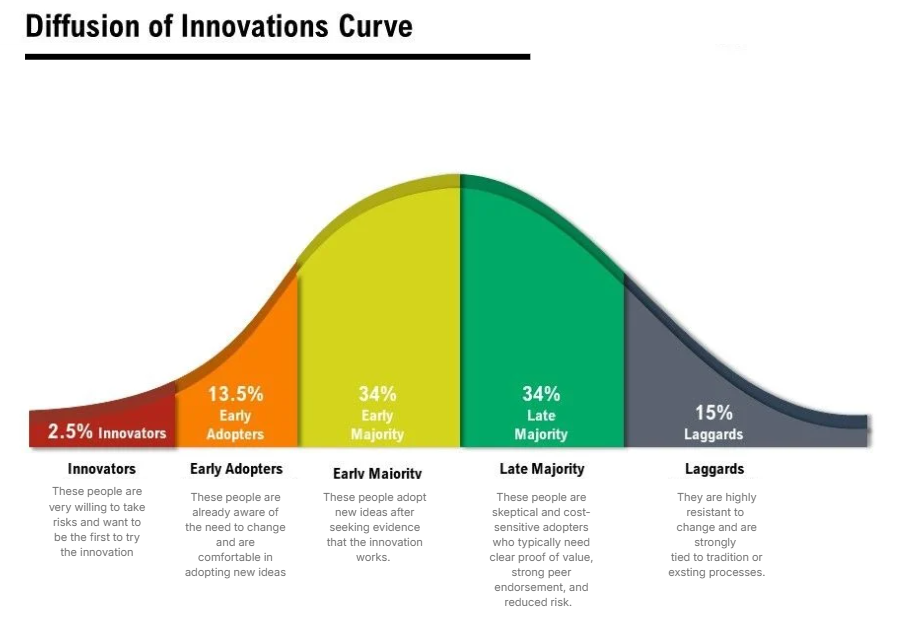
Leverage the Diffusion of Innovation Curve
Not everyone embraces change at the same pace. As described in the “Diffusion of Innovations” adoption curve by Everett Rogers, innovators and early adopters are often eager to try new solutions, while early majority, late majority, and laggards require different forms of engagement, reassurance, and evidence before changes feels acceptable.
Dr. Stern recommends:
- Letting early adopters influence peers
- Using hands-on training to reduce fear
- Sharing strong data and real-world examples
- Avoiding excessive pressure on laggards—they come around when ready
- Consistently highlighting wins to normalize the new practice
Managing this curve strategically prevents frustration and stalled rollouts.
Education Must Be Comprehensive and Continuous
Education isn’t a single event. It’s a cycle.
Key considerations include:
- Training insertion teams, bedside staff, educators, and outpatient partners
- Reinforcing skills during new-hire onboarding
- Ensuring peer-to-peer teaching is correct and consistent
- Using manufacturer tools (videos, QR codes, help lines) rather than reinventing the wheel
- Scheduling regular refreshers
Dr. Stern emphasized that a single negative experience, especially from a vocal staff member, can undermine an entire initiative, highlighting the need for consistent and high-quality education.
Share Data, Celebrate Wins, and Listen
People are more willing to adopt change when they:
- Understand the why
- See measurable results
- Feel appreciated
Dr. Stern encourages teams to:
- Share before-and-after data openly
- Report improvements frequently
- Thank staff for their contributions
- Ask what barriers remain—and remove them collaboratively
Sometimes the obstacle is as simple as: “I can’t find the dressing.” Fixing small issues quickly builds momentum, goodwill, and trust.
Real-World Examples: Successful Implementation of SecurAcath
Dr. Stern shared two powerful examples of how adopting SecurAcath, a subcutaneous anchored securement system, led to measurable improvements in vascular access outcomes. These stories demonstrate not only what changed, but how successful change took root.
1. A Small Community Hospital: Eliminating Sutures and Improving Securement
At his former 200-bed nonprofit hospital, the vascular access team had already identified inconsistent securement and dressing challenges as key contributors to complications. PICC practices had improved, but CVC insertion remained heavily reliant on sutures.
When Dr. Stern arrived, the team saw an opportunity to implement SecurAcath for CVCs.
Once inserters saw:
- how SecurAcath reduced catheter movement,
- how it eliminated suture-related needlestick risk, and
- how much faster it was during high-acuity situations,
adoption accelerated.
Emergency Department clinicians appreciated the speed. Surgeons valued the minimized risk of dislodgement during dressing changes. Intensive Care Unit (ICU) nurses, already familiar with the device from PICC use, adapted quickly.
The result: sutures became rare, securement consistency improved, and clinicians gained confidence knowing catheters were anchored more reliably. The shift also supported improved site-selection practices, including safer placement of lower internal jugular or subclavian lines.
2. A Large 632-Bed Trauma Center: Scaling SecurAcath to Standardize Practice
At Dr. Stern’s current hospital, which is part of a newly merged 21-hospital system, the challenge was larger and more complex. The facility had the highest CLABSI rate in the system when he arrived.
Root-cause analysis revealed persistent issues with:
- oily or diaphoretic skin,
- high catheter movement,
- poor CHG site visibility, and
- inconsistent securement practices across units.
Introducing SecurAcath became central to the improvement plan.
A focused trial showed:
- improved stabilization,
- more consistent CHG placement, and
- fewer dressing disruptions.
Trauma and surgical teams quickly adopted the device, noting that it was easier and more reliable than sutures. Nurses appreciated the sustained securement and simpler maintenance.
Early improvements led both hospital leadership and the system’s value committee to support expanding the evaluation. Staff even began requesting SecurAcath for high-risk skin profiles—a strong sign of clinical acceptance.
While small barriers appeared (such as forgetting to scan a QR code for data collection), the clinical value was clear. These lessons are now guiding a broader rollout with strengthened education and systemwide alignment.
Final Takeaway: Passion + Process Drives Change
The science, the products, and the evidence all matter, but Dr. Stern believes passion is what truly moves teams forward.
“Find your passion. Find other people’s passion. And don’t be afraid to say when something didn’t work. The goal doesn’t change—you just find another path.”
Access the Full Webinar
This webinar is available on-demand through the AVA Academy and offers free Continuing Education Contact Hours.
Watch the full webinar: “Turning Skeptics into Supporters: Engaging Teams in Product Change.”
Eloquest Healthcare is proud to support ongoing clinical education and knowledge-sharing initiatives. Our goal is to help translate evidence into practice by partnering with clinicians to advance safe, effective care. To receive notifications about future educational programs and clinical content, register here.
For general inquiries or additional information, contact us or call 1-877-433-7626.