
Videos

Video Resources Procedural Videos Mastisol® Liquid Adhesive Vial Application Instructions Detachol® Adhesive Remover Vial Application Instructions SecurAcath® Instructional Video Adhesive Remover Comparison – Detachol vs. Wipe Gum Mastic: What is it and why do I need it for my vascular access dressings? Vascular Access Care & Maintenance: Avoid MARSI during Dressing Changes Modern Vascular Access…

Living Well with Type 1 Diabetes: Balancing Nutrition, Activity and CGM Wear

Living Well with Type 1 Diabetes: Balancing Nutrition, Activity, and CGM Wear Living with type 1 diabetes is a constant balancing act of numbers, decisions and technology. Between keeping track of blood sugar trends and staying on top of the latest technological advances, there’s a lot to manage. In recent years, continuous glucose monitors (CGMs)…

Title Page

The STICKY Trial, Revisited: Deeper Clinical Insights and Lessons Learned

The STICKY Trial, Revisited: Deeper Clinical Insights and Lessons Learned A recent webinar hosted by the Association for Vascular Access (AVA) featuring Nicole Marsh, PhD, RN, offered a rare look at the clinical challenges and decision-making behind the STICKY Trial, offering insight well beyond what appears in the published manuscript. This session discussed the trial…

Safety and Efficacy of Securement Options for PICCs in the Pediatric Population

Safety and Efficacy of Securement Options for PICCs in the Pediatric Population As pediatric vascular access teams continue to refine best practices, securement remains a critical and evolving component of safe catheter care. In this brief video, clinicians Cheryl Gillette, RN, VA-BC, and Kathy Grieser, BSN, RSN, VA-BC, explore emerging evidence on the safety and efficacy of…

Blog Title

Turning Skeptics into Supporters: Leading Successful Product Change in Healthcare

Turning Skeptics into Supporters: Leading Successful Product Change in Healthcare Change in healthcare is never simple, particularly when it involves new products, new workflows, and teams already stretched thin. During a recent Association for Vascular Access I Save That webinar sponsored by Eloquest Healthcare, Michael Stern, MD shared his real-world experience with new product implementation,…

Text: Image of poster

Trading Sutures with Subcutaneous Anchoring Devices for Initial Securement of Tunneled CVCs

Trading Sutures with Subcutaneous Anchoring Devices for Initial Securement of Tunneled CVCs At AVA 2024, vascular access specialist Jedediah Gervacio, MSN, RN, VA-BC presented his clinical poster, “Trading Sutures with Subcutaneous Anchoring Devices for Initial Securement of Tunneled CVCs.” In this video, Jedediah walks us through the driving questions behind his work, the methods he…

An Ounce of Prevention: Why Investing in Better CVC Securement Pays Off. Featured image includes a jugular CVC site with Mastisol Liquid Adhesive being applied.

An Ounce of Prevention: Why Investing in Better CVC Securement Pays Off

An Ounce of Prevention: Why Investing in Better CVC Securement Pays Off In today’s hospitals, every penny counts, and the price of complications associated with catheter failures can be overwhelming. The price tag for a single central line infection can be staggering, not to mention the hidden costs of extended ICU stays, additional treatments, and…

Text: Image with published date listed

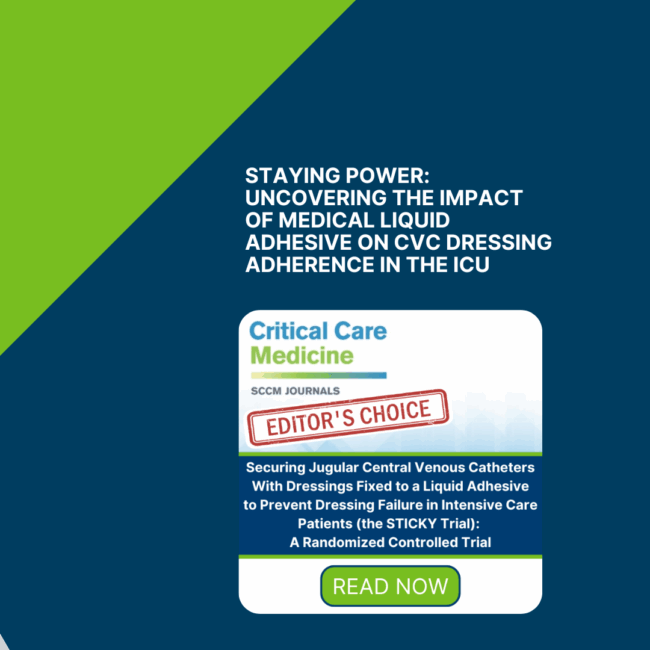
Staying Power Uncovering the Impact of Medical Liquid Adhesive on CVC Dressing Adherence in the ICU

Staying Power: Uncovering the Impact of Medical Liquid Adhesive on CVC Dressing Adherence in the ICU Every day, busy ICU teams struggle with a persistent challenge: central venous catheter (CVC) dressings that fail to stay securely in place. This isn’t just a minor inconvenience—when dressings come loose, the consequences can be severe, including catheter failure,…